Reliable Excavation Pros
You need excavation experts who are familiar with Port Charlotte soils, tides, and utilities. We record borings, categorize soils (USCS), and align dewatering to tide cycles. Our OSHA-compliant trench protection, GPS/laser grading, and density testing deliver exact cuts, trenches, and drainage on compact lots and waterfronts. We handle Sunshine 811, SUE, and inspector hold points, and deliver SWPPP logs, as-builts (NAVD88), and photo documentation. Anticipate stable bedding, riprap/living shoreline solutions, and transparent unit pricing. Keep going to discover how we protect your site.
Main Points
Why Precision Excavation Is Essential in Port Charlotte
Due to the fact that Port Charlotte's soils change from sandy loam to dense caliche near the water table, precision excavation preserves utilities, foundations, and drainage systems while ensuring crews and neighbors safe. You face inconsistent bearing capacity, perched groundwater, and corrosive salt influences that accelerate pipe deterioration. Rigorous grade control and shoring prevent wall sloughing, minimize trench settlement, and minimize damage to existing lines. You'll require utility locates, vacuum potholing, and staged cuts to validate depths without ruptures.
Seaside settling impacts subgrade performance; you address it with proof-rolling, density testing, and calibrated compaction lifts calibrated to moisture content. Around Charlotte Harbor, mangrove preservation isn't optional; you implement access mats, silt curtains, and turbidity monitoring to safeguard both roots and water quality. Instrumented monitoring identifies heave, vibration, and differential movement before they turn into failures.
Residential Site Preparation Done Properly
Beginning with survey stakes and ending at the first concrete pour, residential site prep in Port Charlotte commences with a well-structured plan and more rigorous controls. You kick off by validating benchmarks, utility locates, and FEMA flood elevations, then set erosion controls to preserve canals and swales. Next, you manage sod removal with sharp edges and appropriate haul-off, eliminating contamination of base materials.
You establish subgrade using precision laser leveling, compact through systematic lifts, and proof‑roll for bearing verification. For driveway groundwork, you set correct crown or cross‑slope, place stabilized base layers, and compact per specifications ensuring pavers or concrete remain stable. You perform deeper excavation for footings as required, create drainage pathways, and control groundwater using sump systems. During all phases, you record density measurements, preserve site access, and ensure safety and regulatory compliance.
Commercial Trenching, Grading, and Land Clearing
You require utility trenching solutions that identify, excavate, and place lines with code-compliant shoring and specific depths for Port Charlotte's high water table and sandy soils. We plan dewatering, traffic control, and utility coordination to stop utility conflicts and stay on inspection schedule. For grading excellence, we set laser-controlled elevations, control stormwater according to Charlotte County standards, and compact to spec for reliable pads and pavements.
Utility Trenching Services
Handle utility trenching with a group that knows Port Charlotte's subsurface conditions, permitting, and safety codes. You get meticulous layout for power, communications, water, and sewer, executed with engineered shoring, trench boxes, and daily utility locates to minimize risk. We adjust trench depth, width, and slope to specification, then install secure pipe bedding and level conduit pathways that keep separation, bend radius, and pull tensions.
Our crews observe groundwater behavior, tidal influence, and sandy strata common in Charlotte County, modifying dewatering and spoil management appropriately. We test compaction in lifts, backfill with graded materials, and document as-builts for inspection teams and utility companies. You'll meet FDOT, NEC, and municipal standards while keeping adjacent services secure and live traffic operating through controlled access and visible signage.
Professional Site Grading
With utilities mapped, protected, and installed to spec, site grading establishes the foundation for pavement, pads, and drainage that operate in Port Charlotte's tidal-influenced water table and sandy soils. We deliver elevations cut and filled to precise tolerances, managing onsite soils with import when necessary to maintain bearing capacity and positive flow. We coordinate, bench, and proof-roll compaction testing to validate densities for foundation support and base courses. To control erosion and surge events from tides, we deploy slope stabilization, armored swales, and geotextile separation over weak lenses. We set grades to local County and FEMA standards, linking finish surfaces to inlets, outfalls, and retention features. Our crew keeps safe haul routes, staged access, and compliant stormwater controls so your schedule and compliance stay on track.
Water Drainage Systems and Erosion Management
Through saturated summer storms to tidal surges, successful drainage and erosion control in Port Charlotte starts with a precise site assessment. You evaluate soil permeability, existing slopes, outlet elevations, and tidal backflow risks, then create conveyance paths that safeguard foundations and utilities.
You manage surface runoff via graded swales, curb cuts, and stabilized outlets, preventing ponding close to structures. Where subsurface relief is required, you designate French drains with perforated pipe, filter fabric, and graded aggregate, guaranteeing positive discharge to lawful outfalls. Along canals and retention edges, you reinforce banks with riprap installation calibrated to local wave energy and boat wake conditions, keyed below grade to prevent undermining.
You likewise integrate native littoral plantings, sediment controls, and maintainable access points to provide long-term system performance.
Tools, Techniques, and Safety Standards
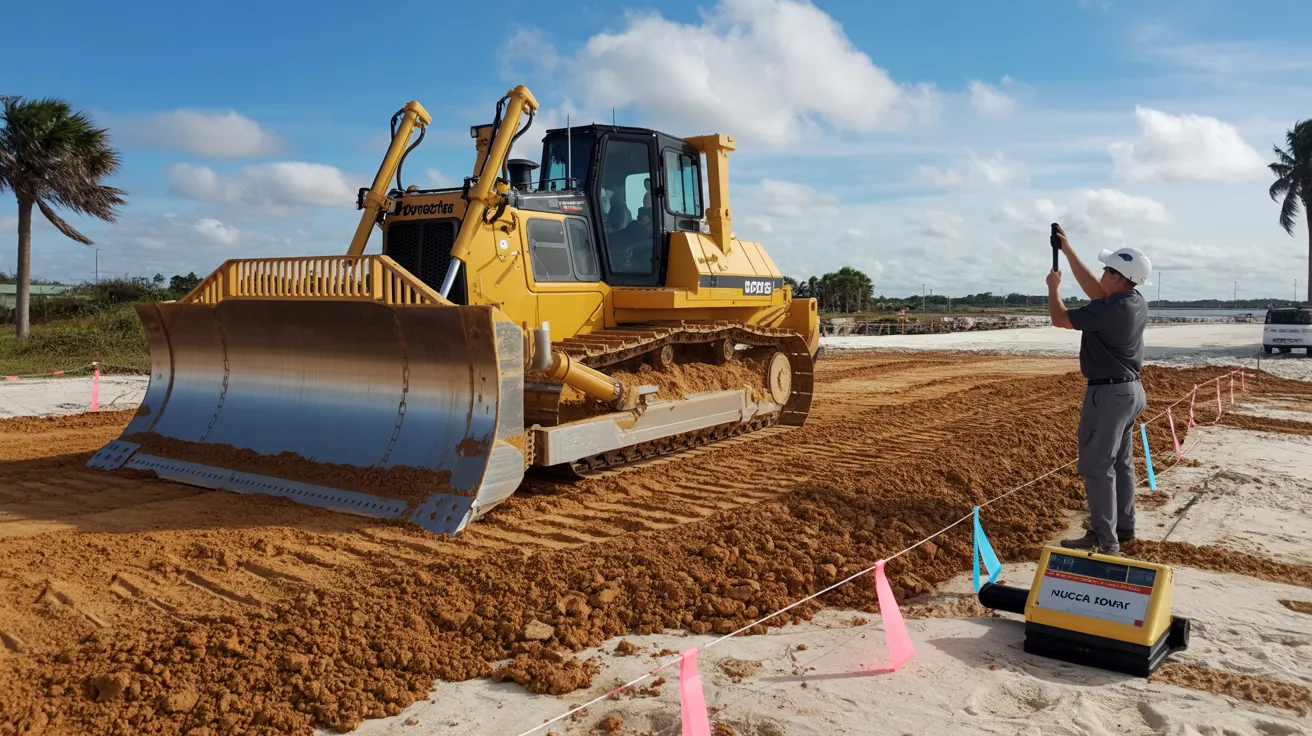
After designing drainage and shoreline controls for Port Charlotte's soils and tides, you put into action the right machinery and techniques to install them safely and to spec. You bring in low-ground-pressure excavators, compact track loaders, and marsh mats to preserve soft coastal subgrades. For hardpan or coral fragments, you utilize hydraulic breakers, maintaining vibration within limits near seawalls and utilities. You shape subgrade with GPS dozers, then finish with laser grading to satisfy fall tolerances for culverts and swales.
You stage traffic control, indicate utilities, and update crews on tide windows, heat stress, and lightning protocols. Spotters manage swing radii and overhead hazards; trench boxes and benching maintain wall stability. You confirm compaction with nuclear density tests and watch rainfall to eliminate pump-outs and blowouts.
Soil Assessments, Permit Services, and Compliance
As coastal soils in this area range from muck to cemented hardpan, you begin by recording borings, Shelby tube samples, and groundwater elevations across tide cycles to map bearing capacity, permeability, and sulfate/chloride exposure. You specify ASTM-compliant Soil Sampling, classify strata with USCS, and flag organics, fines, and aggressive chemistry that can corrode concrete or steel. You set excavation slopes and dewatering rates from grain-size curves and hydraulic conductivity, preserving adjacent foundations and canals.
When handling permits, you manage Permit Navigation across Charlotte County, SWFWMD, and FDEP thresholds, coordinating cut/fill with stormwater and floodplain regulations. You submit erosion and turbidity BMPs, NPDES coverage, and dewatering discharge plans including monitoring points. You maintain records of compaction, density, and proof-roll results to comply with code, and preserve chain-of-custody for all samples.
Working Together With Builders, Service Providers, and Inspectors
You organize preconstruction planning meetings to synchronize scope, grading tolerances, haul routes, and stormwater controls with Port Charlotte builders. You manage utility locates through Sunshine 811, check as-built records, identify tolerances, and define safe standoff zones ahead of the first cut. You maintain inspection-ready documentation—SWPPP logs, compaction reports, load tickets, and redlined site plans—for county inspectors to clear holds without delay.
Pre-Construction Planning Sessions
Begin with a focused preconstruction meeting that synchronizes builders, underground utility providers, and county inspectors on scope, sequencing, and safety. You'll verify design intent, soil classifications, haul routes, and access constraints unique to Charlotte County rights-of-way. Utilize site surveying data to validate benchmarks, elevation controls, and erosion limits prior to staking. Define risk allocation early: define responsibilities for dewatering triggers, unsuitable material removal thresholds, and weather contingency protocols.
Establish communication frequency, submittal paths, and inspection hold points for clearing, grading, and compaction. Align traffic control plans, work hours, and stormwater BMPs to meet county ordinances and FDOT standards applied locally. here Document equipment requirements, spoil management areas, and testing procedures (soil density, moisture, and proctor). Conclude with a written action log, clear owner directives, and a go/no-go checklist.
Utility Locating Coordination
Once preconstruction roles and hold points are established, move directly into utility locate coordination to preserve existing assets in Charlotte County ROWs and easements. Start by opening Sunshine 811 tickets, recording all member responses, and verifying positive response codes before beginning any work. Preserve meticulous ticket tracking with updates to account for lifespan limits and work-area expansions.
Organize field walks with builders, utility owners, and county inspectors to verify marks, depths, and conflict points. Employ SUE levels in areas where risk is high, and pothole critical crossings using vacuum excavation. Define no-cut buffer zones around gas, reclaimed, fiber, and force mains, and require spotters when performing mechanical digs within tolerance zones.
Schedule work windows considering utility outages, lane closures, and school traffic patterns to mitigate risk and copyright compliance.
Inspection-Ready Documentation
Even though field coordination decreases surprises, inspectors in Charlotte County expect inspection-ready documentation that proves control of the work zone and utilities. You'll accelerate approvals by issuing a complete package before the walk-through. Include signed utility clearances, OSHA-compliant trench protection plans, compaction test results, and traffic control layouts following county standards. Attach geo-tagged digital photos displaying utility marks, protective shoring, spoil placement, and erosion controls at key milestones.
Supply current as built records with both horizontal and vertical measurements tied to local benchmarks and utility depth verifications. Label valve boxes, duct banks, and service laterals with stationing and materials. Preserve a daily log: crew, equipment, weather, call-in tickets, and field changes. Share documents to builders and utility contacts 24 hours beforehand so inspectors can confirm safety, compliance, and readiness.
Waterfront and Confined-Space Excavation Expertise
Throughout Port Charlotte's canals and compact infill lots, precision excavation hinges on tidal awareness, soil stabilization, and strict compliance with Charlotte County and SWFWMD regulations. You'll gain from crews who schedule cut-and-fill around tide cycles, employ turbidity controls, and protect adjacent seawalls and utilities. We verify soil profiles, specify dewatering systems or cofferdams, and compact lifts to meet bearing requirements without causing lateral movement.
On compact sites, we position low-impact equipment, establish exclusion zones, and employ spotters to maintain setback clearances. For shoreline access and dock integration, we grade approach ramps, align foundation elevations with FEMA and local freeboard requirements, and install erosion control that complements riprap or living shorelines. Anticipate precise benchmarks, as-builts tied to NAVD88, and secure, efficient mobilization logistics.
Upfront Rates, Scheduling, and Contact
From your initial contact, we deliver a scope-defined, itemized proposal that itemizes mobilization, erosion control, excavation volumes (cut and fill by cubic yard), dewatering method, haul‑off, compaction testing, and restoration—completely transparent pricing. We deliver upfront estimates customized for Port Charlotte soils, groundwater characteristics, and haul routes, guaranteeing that quantities and production rates match reality and safety margins.
We secure schedule windows around utility locates, tide cycles, and rainfall projections, then establish milestones: pre-con, mobilization, excavation, inspections, backfill, and final grade. You'll get clear updates via daily logs: crew, equipment, CY moved, Proctor/moisture results, and any deviation with corrective actions. Change orders specify drawings, pay items, and revised durations before work proceeds. Permitting status, MOT plans, and site controls continue to be transparent, decreasing risk and avoiding downtime.
Frequently Asked Questions
Do You Offer Storm-Response or Emergency Excavation Services in Port Charlotte?
Yes, you can request emergency excavation and storm-response services in Port Charlotte. We provide 24/7 response with swift mobilization, utility locates, traffic control, and certified operators. Our team evaluates soil stability, tidal influence, and groundwater from the Myakka and Charlotte Harbor basins before cutting or dewatering. We deploy vacuum excavation for damaged utility corridors, armored berms for washouts, and temporary shoring following OSHA Subpart P. We provide clear incident documentation and coordinated permitting.
Are You Available to Assist With Locating and Securing Archaeological or Historical Resources?
You can receive expert support finding and safeguarding archaeological or historical resources. Worried it will delay your timeline? We simplify compliance with strategic site surveys, GIS mapping, and coordination with county preservation officers. You'll receive phased assessments, permit-ready documentation, and on-site artifact monitoring to prevent accidental disturbance. We establish exclusion zones, utility-clearance protocols, and stop-work triggers, conforming with Florida statutes. You will preserve heritage, maintain safety, and keep your Port Charlotte project on track.
What Warranties and Workmanship Guarantees Can You Provide Following Excavation?
You receive clear warranty options and written workmanship guarantees on all excavation stages. We warrant compaction density, trench backfill, and subgrade prep to specified ASTM/FDOT standards, with defined correction periods. If settlement, improper slopes, or utility bedding failures arise, we'll remediate to plan at no cost. We record as-builts, compaction tests, and utility locates, and mandate post-rain inspections. Coastal soils, high water table, and SWFL code nuances are included in your warranty scope.
What Methods Do You Use to Minimize Noise, Dust, and Disruption for Neighboring Properties?
You minimize noise, dust, and disruption by sequencing work, implementing quiet hours, and employing low-decibel equipment. You organize traffic to prevent blockages and install temporary barriers and water misting for dust control. You incorporate rubber track mats, mufflers, and backup alarms with white-noise. You establish vibration monitoring near sensitive structures and alter methods if thresholds near limits. You arrange utility locates, post signage, keep clean haul routes, and inform neighbors on schedules and changes.
Does Your Company Provide Post-Excavation Site Cleanup and Debris Removal Services?
We provide full post-excavation site cleanup and debris hauling. We separate spoils, coordinate post demolition cleanup, and handle material recycling logistics per Charlotte County requirements. Our crews perform load-out with calibrated equipment, ensure DOT-compliant hauling, and track manifests. We clear access roads, stabilize grades, and install temporary erosion controls. You'll receive receipts for disposal and final site photos. We work around utility locates and HOA rules to deliver safe, quiet, code-compliant demobilization.
Final copyright
You might take chances with speculation, or you might opt for Port Charlotte experts who laser-grade, compact to spec, and pull permits before coffee. You'll get soil reports that don't read like astrology, trench shoring that doesn't rehearse for failure, and waterfront digs that acknowledge tides, easements, and manatees. We will work alongside utilities, inspectors, and your builder, then log every utility locate and soil compaction test. Transparent pricing, tight schedules, zero surprises—because "making it up as you go" isn't an excavation method.